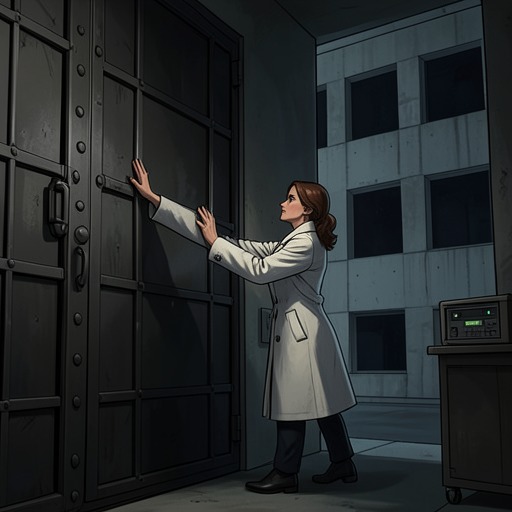
Fichero de Hidalgo
Ofrenda a la tormentaFichero de Hidalgo is the name given to a collection of records sought in Amaia Salazar’s investigation into suspicious infant deaths and a secretive group in Baztán. Its decisive significance lies partly in what it may have contained and partly in what the search found instead: boxes emptied and a file reduced to ashes before officers arrived. The destruction deprived the inquiry of a potential documentary trail, while its timing made the missing papers evidence of a different kind—evidence that information about the investigation may have reached Fina Hidalgo in advance.
The records and the case around them
Amaia’s inquiry connects the file to a history of meetings at Argi Beltz, a country house in Orabidea where a sect-like group gathered in the late 1970s and early 1980s. Elena Ochoa, a friend of Amaia’s family, had described a community that began with cultural and spiritual meetings but moved toward occult practices and animal sacrifice; she left when the rites became too savage. Amaia later located the house and found that the original hosts, now a wealthy retired couple, still lived there. They acknowledged knowing Berasategui, although they did not explain their relationship with him.
That history gave the missing records investigative importance, but the evidence did not establish exactly what the Fichero de Hidalgo contained. Amaia was examining several infant deaths that had initially been classified as cot deaths. The cases attracted renewed attention because of the parents’ reactions, concerns raised by social services in some families, and connections between the families and the meetings at Argi Beltz. Amaia’s account placed the group, the house, and the Hidalgo family within the same developing line of inquiry; it did not make the absent file itself proof of a particular crime.
A separate document helped expose a discrepancy in the story told about Ainara Martínez Bayón, the daughter of the couple living at Argi Beltz. Her birth certificate recorded a home birth on March 12, 1979, at Argi Beltz in Orabidea, and bore the signature of Doctor Hidalgo. The family claimed that Ainara had died of a stroke while travelling in the United Kingdom, but investigators found no British hospital record, death certificate, autopsy record, or trace of the child’s death in the Spanish family register. They were also checking whether the travel documentation required for a minor to leave Spain had existed. These independent records raised questions about Ainara’s fate; the narrative does not establish that her birth certificate was part of the Fichero de Hidalgo.
The search and the destruction
Amaia went to search the Hidalgo property with a printed warrant, arriving with her team in the morning. Fina Hidalgo opened the door promptly and appeared prepared for them. She directed the officers toward the office they wanted to search. In the room, Amaia saw dated cardboard boxes on a table. The boxes were empty, and their lids had been thrown on the floor in haste. Fina entered behind her and presented the loss as an unfortunate coincidence: she said the papers had been stored for years by her brother, that she had kept them as a kind of memento, and that she had begun clearing the dusty office the previous day after someone reminded her of the files.
The timing turned that explanation into a point of contention. The search warrant focused on a particular file, and the only thing burned during the early-morning cleanup, according to the officers, was that file. When Amaia later described the search, she said the team had found nothing but ashes and that Fina claimed to have been cleaning. The surviving evidence therefore distinguishes between a record that investigators could not find and a record they had reason to believe had been deliberately destroyed. The ashes confirmed its destruction; they could not supply its contents or establish what each paper had recorded.
The leak question
The destruction also prompted suspicion that somebody had warned Fina. Amaia had considered the possibility that a member of her Elizondo team was responsible for an earlier leak, although she said she had set the theory aside after considering it and continued to trust her officers. Internal Affairs later connected that concern to Jonan Etxaide’s access to Amaia’s computer. A forensic specialist reported that Jonan had remotely accessed her machine as many as twenty times in the preceding month, reaching her email and folders and copying files. The method required both computers to be on and a password to be entered on Amaia’s computer; the investigators concluded that the access had to take place from the station.
The timing was particularly troubling: Jonan had accessed Amaia’s email on the night before the search and again that morning. The officers reasoned that he therefore knew about the information in it. Amaia tried to account for the access as possibly related to large photographs he had been due to send, but the investigators stressed that he had never told her he was entering her computer. She denied having authorized or been informed of the repeated access. This established covert access and knowledge of the search-related information, not direct proof that Jonan had alerted Fina or that he had caused the file to be burned. The distinction remains important: the file’s destruction and the unauthorized access converged in the inquiry, but the evidence presented did not itself demonstrate the exact route by which the warning, if there was one, had reached the house.
What the missing file leaves unresolved
The Fichero de Hidalgo belongs to a wider pattern of documentary gaps, but it must not be confused with Berasategui’s separate encrypted clinical files. Those files reportedly catalogued cases from his clinic and private work, including the Esparza case. After Berasategui’s arrest in connection with Rosario Salazar’s release and the crimes known as the Tarttalo cases, Vatican authorities reviewed and removed a selection of his records to Rome, judging them unrelated to the police investigation but disturbing in nature. That transfer was a separate loss of access: the Fichero de Hidalgo had been burned at the Hidalgo property, whereas Berasategui’s files had been taken away by Vatican authorities.
Together, the different records and their fates shape what the investigation can know. A signed birth certificate, missing death documentation, absent travel records, a burned file, and encrypted clinical records transferred abroad do not all carry the same evidentiary meaning. Some documents exist and attest to specific details; some expected records could not be located; others were physically destroyed or removed from police access. The Fichero de Hidalgo is most consequential as the investigation’s deliberately inaccessible archive: its disappearance deepens suspicion around the search and narrows the documentary basis on which Amaia can test the links among the families, the old group, and the infant deaths.